The Do's and Don'tsBy Kel Healthcare Team
The Do's and Don'ts of Easing Cold Symptoms
Adults catch 2 to 3 colds a year, yet fewer than half of Americans know antibiotics can't treat one. Here's what actually eases cold symptoms, and what only makes them drag on.

Introduction
Adults catch 2 to 3 colds a year, yet fewer than half of Americans know antibiotics can't treat one. Here's what actually eases cold symptoms, and what only makes them drag on.
The average adult catches 2 to 3 colds a year, and children get even more, according to the CDC figures cited by Mass General Brigham. Yet fewer than half of Americans realize antibiotics are useless against a cold, per a Harris Poll for the Merck Manuals. So the problem isn't catching a cold. It's treating it wrongly. Here's what actually helps, and what quietly makes things worse.
Key Findings
- 2 to 3 colds a year is the average for adults (Mass General Brigham).
- 49% of Americans correctly knew antibiotics don't treat colds (Merck Manuals survey).
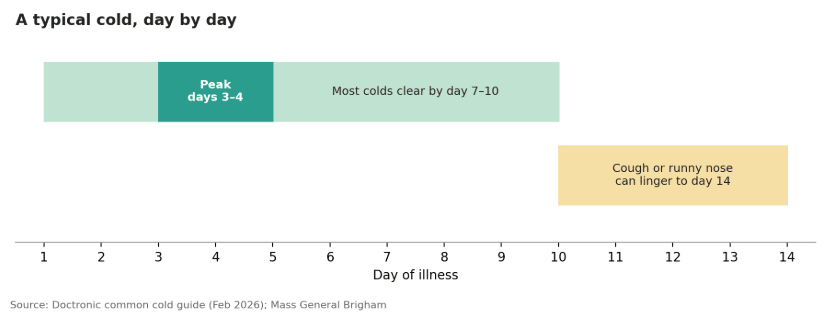
- 10 to 14 days is how long a cough or runny nose can linger, even in an ordinary cold (Mass General Brigham).
- 3 times more likely to catch a cold virus: people sleeping under five hours a night, according to a physician quoted by News4Jax.
Why do we keep getting the common cold wrong?
Because it's so ordinary that we stop paying attention. The common cold leads to more provider visits and missed school and work days than any other illness, Cedars-Sinai notes. That familiarity breeds shortcuts: the leftover antibiotic, the "just push through" workday, the megadose of vitamins.
None of these shortcuts shorten a cold. A cold is a viral infection of the nose and throat. Your immune system does the real work, and your job is simply to make that work easier. Think of it as managing cold symptoms, not fighting the virus.
What should you do when a cold hits?
Rest and fluids are the foundation. Cedars-Sinai lists them as the core treatment for reducing symptoms. They sound too simple to matter, but they are exactly what a recovering body asks for.
- Sleep more than you think you need. If short sleep is linked to catching a cold in the first place, it's reasonable to expect that protecting your sleep helps you recover.
- Drink warm liquids. Water, broth, and herbal tea thin mucus and soothe a scratchy sore throat.
- Use saline for nasal congestion. A saltwater spray or rinse with distilled or boiled-and-cooled water loosens thick mucus without medication.
- Run a humidifier. Moist air eases a dry throat and nasal congestion. Clean it regularly so it doesn't grow mould.
- Ask a pharmacist before buying combination products. Several cold medicines hide the same active ingredient, and doubling up is an easy mistake.
What should you avoid?
Anything that promises more than comfort. Antibiotics, in particular, don't help. The Merck Manuals state they don't work for colds even when mucus turns thick or coloured. One physician quoted by News4Jax adds that using them needlessly feeds antibiotic resistance in the whole community.
| Do | Don't |
| Rest and sleep as much as possible | Push through a full workday on four hours of sleep |
| Sip warm fluids through the day | Rely on alcohol or heavy caffeine to "feel better" |
| Use saline for a stuffy nose | Take leftover antibiotics |
| Wash hands often | Share towels, cups or pillows |
| Check labels on combination cold medicines | Stack several medicines with the same ingredient |
| Stay home when you're feverish or coughing hard | Assume vitamin C will cure it (a physician in the News4Jax piece says studies show no benefit) |
When should you stop home care and call a doctor?
When the pattern stops looking like a cold. Complications are unusual, per Cedars-Sinai, but they happen. Reach out to a healthcare provider if you notice:
- A high fever, or a fever that returns after improving
- Symptoms lasting well beyond two weeks
- Chest pain, wheezing, or trouble breathing
- Severe ear pain or facial pain

Because cold symptoms overlap with flu, RSV, and COVID-19 (Mass General Brigham), a sudden, severe onset with body aches is worth a closer look.
How do you stop the cold from spreading at home?
Wash your hands and keep them away from your face. Cedars-Sinai calls frequent hand washing and keeping distance from sick people the best prevention. If someone in your home has a cold, give them their own towel, wipe doorknobs and remotes, and open a window when the weather allows.
Conclusion
A cold is rarely dangerous, and it rarely needs a pharmacy shelf's worth of products. Treat the common cold with simple home remedies (sleep, warm fluids, saline, and patience), avoid the antibiotic trap, and watch for the red flags above. Most people feel clearly better within about a week, even if a cough lingers.
Frequently Asked Questions
More from our blog
 Osteoarthritis and Chronic Joint Pain
Osteoarthritis and Chronic Joint Pain: Staying Active With a Long-Term Plan
Osteoarthritis is a leading cause of chronic joint pain, but a long-term plan built around movement, weight management, and safe pain relief can help you stay active and independent.
Medically reviewed by Dr. Karl E. Latortue, MD
Read Article Chronic Disease
Chronic Disease Flare-Ups: When to Call Your Doctor, Visit Acute Care, or Go to the ER
Not every flare-up is an emergency, but some are. Learn how to recognize early warning signs and decide between calling your doctor, visiting urgent care, or dialing 911.
Medically reviewed by Dr. Karl E. Latortue, MD
Read Article Bloodwork Results
High or Low Red Blood Cell Count? What Your Bloodwork Is Telling You
Seeing a high or low red blood cell count on your lab report? Learn what RBC, hemoglobin, and hematocrit results mean, what can cause abnormal levels, and what happens next.
Medically reviewed by Dr. Karl E. Latortue, MD
Read Article