Diagnostic TestingBy Kel Healthcare Medical Team
Understanding Your Diagnostic Testing Results Without the Guesswork
How to read a lab report step by step, what reference ranges actually represent, what the common abbreviations mean, and when a flagged value is worth a call to your doctor.
Introduction
Getting a results notification and staring at a page full of numbers, ranges, and abbreviations can feel more confusing than reassuring. Most people don’t have a medical background, so when a report says something is “outside reference range,” it’s natural to feel a spike of worry before you even know what that actually means.
This guide walks through how to read your diagnostic testing results step by step, what common terms and abbreviations mean, and how to tell the difference between something worth a quick follow-up call and something that needs immediate attention. We’ll also cover how bloodwork results are typically organized, what “normal ranges” really represent, and how to find diagnostic testing near me if you need a repeat test or a second opinion.
None of this replaces a conversation with your doctor. The goal here is to help you walk into that conversation informed, with fewer surprises and better questions.
Why Diagnostic Testing Results Feel Confusing
Lab reports are written for clinicians, not patients. That’s the core issue. The terminology, units, and formatting are standardized for medical professionals who read hundreds of these a week, not for someone checking a patient portal on their phone.
A few reasons diagnostic testing results feel harder to interpret than they should be:
- Reference ranges vary slightly between labs and testing methods
- A single “high” or “low” flag doesn’t tell you the clinical significance
- Many values are only meaningful in combination with others, not alone
- Portals often show results before a doctor has reviewed or contextualized them
Knowing this upfront can take some of the anxiety out of seeing an unfamiliar flag on your report.
Why Results Sometimes Arrive Before Your Doctor’s Notes
Many patient portals release lab results automatically, often before your provider has had a chance to review them. This means you may see a flagged value hours or even days before getting any clinical context. That gap is normal, not a sign that something has been missed.
How to Read Your Lab Test Results Explained
Once you understand the basic structure of a lab report, the rest gets much easier. Most reports follow a consistent format regardless of which panel was ordered.
Every result typically includes:
- The name of the test
- Your value
- The unit of measurement
- The reference range for that lab
- A flag (H, L, or nothing) if your value falls outside that range
Reading the Reference Range Column
The reference range represents the values seen in a large sample of healthy people, not a strict line between “fine” and “not fine.” Falling slightly outside a range is common and often not clinically significant on its own, especially for a single test.
Understanding Bloodwork Results Categories
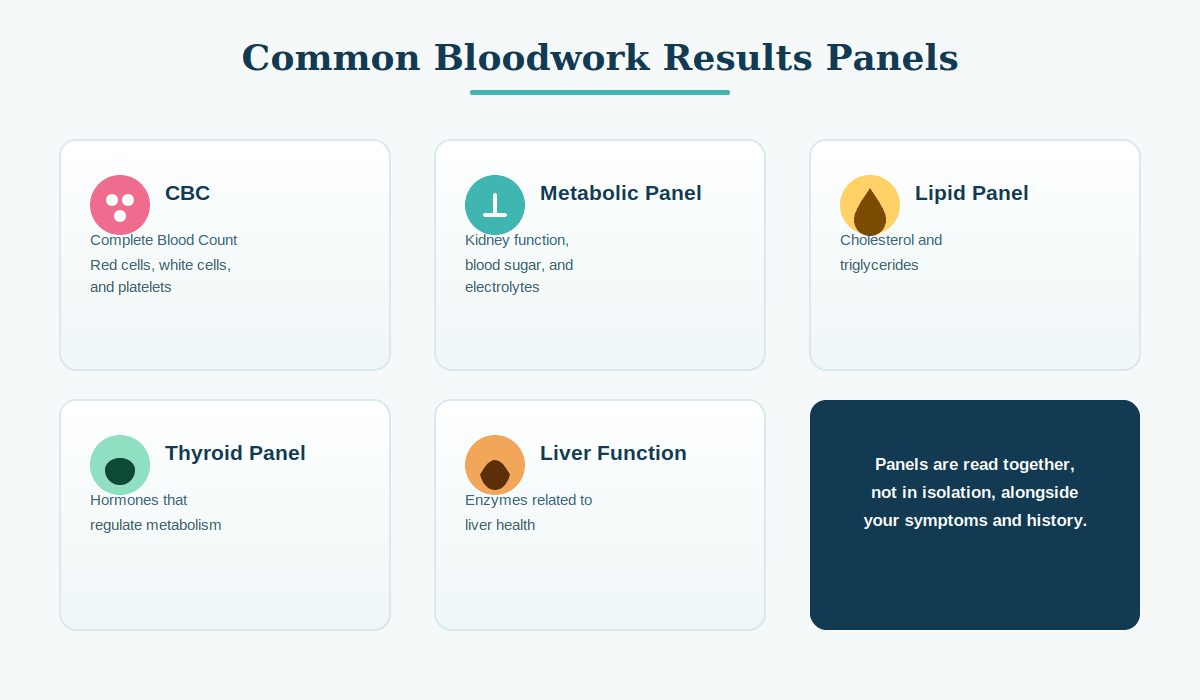
Bloodwork results are usually grouped into panels, and knowing which panel you’re looking at helps you understand what’s actually being measured.
Common panels include:
- Complete Blood Count (CBC): evaluates red blood cells, white blood cells, and platelets
- Basic or Comprehensive Metabolic Panel: evaluates kidney function, blood sugar, and electrolytes
- Lipid Panel: evaluates cholesterol and triglycerides
- Thyroid Panel: evaluates hormones that regulate metabolism
- Liver Function Tests: evaluate enzymes related to liver health
Why Panels Are Read Together, Not in Isolation
A single elevated value in a panel is rarely meaningful on its own. Doctors typically look at patterns across several related markers, along with your symptoms and history, before drawing any conclusions. This is one of the biggest reasons self-diagnosing from a single flagged number can be misleading.
What “Reference Ranges” Actually Mean
Reference ranges are statistical, not diagnostic. They’re typically built from a large group of people considered healthy, and represent the range within which about 95% of that group’s results fell.
A few important nuances:
- Being outside the range doesn’t automatically mean something is wrong
- Being inside the range doesn’t guarantee nothing is wrong
- Ranges can differ by age, sex, pregnancy status, and the lab performing the test
- Some values naturally fluctuate day to day based on hydration, diet, or time of day
Why Your Personal Baseline Matters
Doctors often care more about how your results change over time than about a single reading. A value that’s technically “normal” but has shifted significantly from your usual baseline can sometimes be more informative than one that’s slightly outside the standard range but consistent for you.
Common Terms and Abbreviations on a Lab Report
Diagnostic testing results are full of abbreviations that make sense to clinicians but rarely to patients. Here are some of the most frequently seen:
- WBC: White Blood Cell count, related to immune function
- RBC: Red Blood Cell count, related to oxygen transport
- Hgb / Hct: Hemoglobin and Hematocrit, related to anemia screening
- A1C: Average blood sugar over roughly the past three months
- LDL / HDL: “Bad” and “good” cholesterol markers
- TSH: Thyroid-Stimulating Hormone, used to screen thyroid function
- eGFR: Estimated Glomerular Filtration Rate, related to kidney function
A Note on Units
Some labs report the same test in different units (for example, mg/dL versus mmol/L), which can make it look like results changed dramatically when they haven’t. Always compare values using the same unit before assuming something has shifted.
When to Call Your Doctor About Your Results
Most flagged results are not emergencies, but a few situations warrant a prompt call rather than waiting for your next scheduled appointment.
Reach out sooner rather than later if:
- A result is flagged as critically high or critically low
- Your provider’s portal includes a message asking you to call
- You’re experiencing symptoms that match a flagged value
- A repeat test shows the same abnormal result as a previous one
What Not to Do While Waiting for Clarity
Try to avoid searching a single lab value in isolation and assuming the worst-case explanation applies to you. Diagnostic testing results are meant to be interpreted alongside your symptoms, history, and other markers by a professional who has the full picture.
Finding Diagnostic Testing Near Me
If your doctor has recommended a repeat test, an additional panel, or a second opinion, it helps to know your options for diagnostic testing near me.
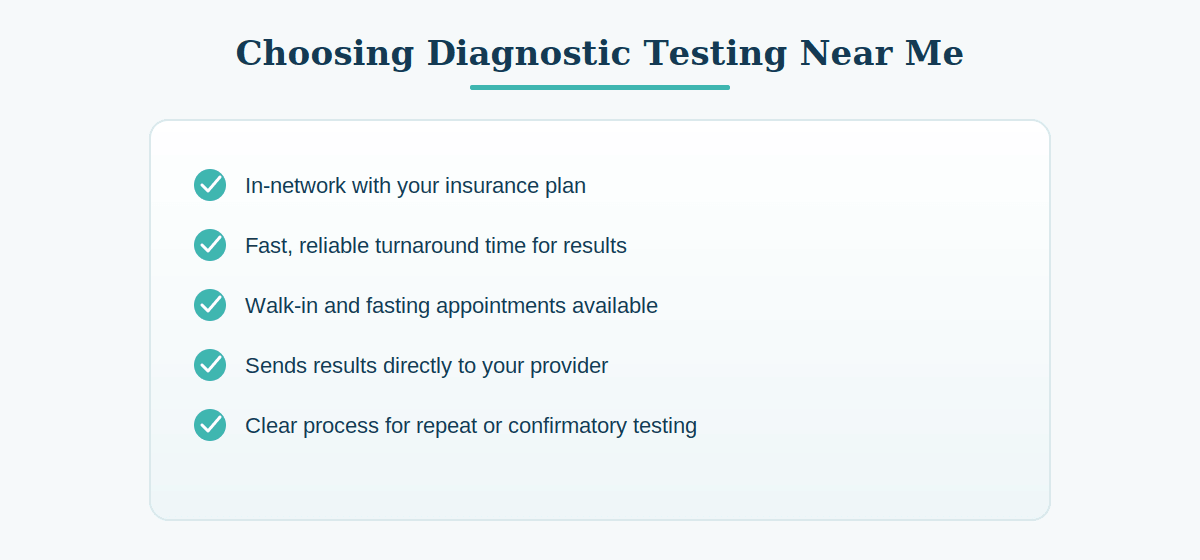
Things to consider when choosing a testing location:
- Whether the lab is in-network with your insurance
- Turnaround time for results
- Whether walk-in or fasting appointments are available
- Whether the facility sends results directly to your provider
Conclusion
Diagnostic testing results can look intimidating at first glance, but most of that feeling comes from unfamiliar formatting rather than actual cause for concern. Once you understand how reference ranges work, how panels are grouped, and what common abbreviations mean, a lab report becomes far less mysterious.
Lab test results explained in isolation are never the full story. Your bloodwork results are just one piece of a larger picture that includes your symptoms, history, and how your values change over time. If something on your report doesn’t make sense, or a value is flagged, the right next step is always a conversation with your healthcare provider rather than guessing based on the number alone.
If you’re due for testing or want a second opinion on a recent result, look into diagnostic testing options that work with your insurance and can share results directly with your doctor, or book an appointment with our team.
Frequently Asked Questions
More from our blog
 IV Therapy
IV Drip Therapy Benefits: A Complete Guide to Vitamin Infusions
What intravenous nutrient therapy actually does, why absorption is the whole argument for it, who tends to benefit most, and the safety considerations worth knowing before your first session.
Medically reviewed by Kel Healthcare Medical Team
Read Article Geriatric Care in Queens
Geriatric Care in Queens: Healthcare Services for Older Adults
There's a shift that tends to sneak up on families as parents or grandparents get older. Suddenly there are more pill bottles on the counter, more appointments to keep track of, and the kind of care.
Medically reviewed by Dr. Karl E. Latortue, MD
Read Article Premier Physicians
How Woodside Premier Physicians Doctors Help You Stay Healthy Year-Round
Staying healthy is more than scheduling a visit when you are sick. It means having a trusted primary care team that gets to know you, helps you prevent health concerns, and supports you through.
Medically reviewed by Urgent Care Specialist in New York
Read Article