Lifestyle CounselingBy KEL Healthcare Medical Services, P.C.
How Lifestyle Counseling Can Help You Live Your Healthiest Life
Lifestyle counseling helps you improve your health through six key pillars: healthy nutrition, physical activity, restorative sleep, stress management, social connections, and avoiding risky substances. Start with small, realistic changes and seek professional guidance to build sustainable habits, prevent health problems, and manage chronic conditions with support from KEL Healthcare.

Introduction
Six in 10 U.S. adults live with a chronic disease, and everyday habits are among the biggest risks. Here's a six-pillar plan, and how lifestyle counseling helps you start small.
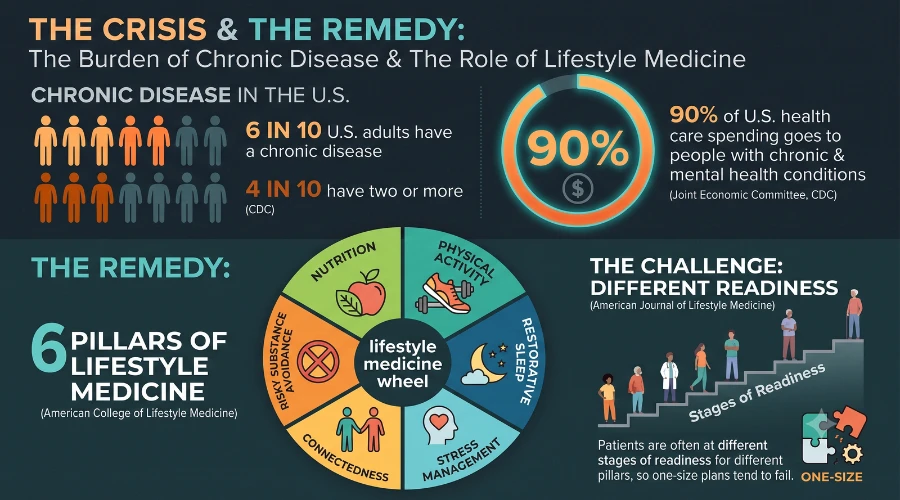
According to the CDC, 6 in 10 adults in the United States have a chronic disease, and 4 in 10 have two or more. A Joint Economic Committee analysis of CDC figures found that chronic and mental health conditions account for 90% of U.S. health care spending. The CDC also points to a short list of lifestyle risks behind many of these conditions, including tobacco use, poor nutrition, physical inactivity and excessive alcohol. The encouraging part is that these risks are habits, and habits can change. Here's how to build your healthiest life one pillar at a time, and where lifestyle counseling services fit in.
Key Findings
- 6 in 10 U.S. adults have a chronic disease and 4 in 10 have two or more (CDC).
- 90% of U.S. health care spending goes to people with chronic and mental health conditions (Joint Economic Committee, citing CDC).
- 6 pillars form the framework of lifestyle medicine: nutrition, physical activity, restorative sleep, stress management, connectedness and risky substance avoidance (American College of Lifestyle Medicine).
- Different readiness: patients are often at different stages of readiness for different pillars, so one-size plans tend to fail.
What Does a "Healthiest Life" Really Mean?
Not perfection, but steady progress across six connected areas. The American College of Lifestyle Medicine describes six pillars. They interact: better sleep makes exercise easier, exercise eases stress and stronger relationships make habits easier to keep. The aim is to address root causes of chronic disease, not just symptoms, and you can start with whichever pillar feels most doable.
For additional guidance, explore our article on how lifestyle counseling supports long-term health.
What Can You Do in Each Pillar?
Start with one tiny step per pillar. Here's a realistic first move for each.
| Pillar | A First Step | Why It Helps |
|---|---|---|
| Nutrition | Add one vegetable or whole grain to a daily meal | The ACLM recommends mostly minimally processed plant foods |
| Physical activity | A brisk 10-minute walk, building toward 30 minutes a day | The Harvard study counted 30+ daily minutes as low risk |
| Restorative sleep | Keep a steady bedtime and wake time | Quality sleep supports chronic disease treatment |
| Stress management | Five minutes of slow breathing or a short walk | Gives your body a daily reset |
| Connectedness | One call or visit with a friend each week | Supportive relationships are part of the framework |
| Avoiding risky substances | Ask about quit support, and set alcohol-free days | Tobacco and alcohol are core lifestyle risks |
You do not need to change everything overnight. Start with small habit changes that make the biggest health impact and gradually build a routine that fits your daily life.
How Does Lifestyle Counseling Help You Start?
It turns "I should" into "here's my plan." Counseling doesn't hand you a rulebook. A good clinician or coach helps you with a few practical things:
- Pick the first pillar. You choose the habit you're most ready to change.
- Set a SMART goal. For example, "walk 15 minutes after lunch, four days a week."
- Plan for obstacles. Travel, weather, workload and cravings all need a backup plan.
- Check in. A short follow-up keeps the habit from quietly fading.
Learn more about our lifestyle counseling services to understand how structured guidance can help you work toward realistic and sustainable health goals.
What Does a Realistic First Month Look Like?
Slow, specific and repeatable.
| When | What to Do | How |
|---|---|---|
| Week 1 | Choose one pillar and one goal | Write it down; keep it small enough that you can't fail |
| Week 2 | Track it | A calendar tick or a notes app is enough |
| Week 3 | Add a second small habit | Pair it with something you already do, such as a walk after dinner |
| Week 4 | Review and adjust | What worked? What got in the way? Ask your counselor or doctor for feedback |
For more practical ideas, read our guide to small habit changes that make the biggest health impact.
What Can Go Wrong?
Trying to change everything at once. Because readiness differs from pillar to pillar, a sudden overhaul of diet, exercise, sleep and stress usually collapses within weeks. Another common problem is treating a setback as failure. A missed week is information about what to adjust, not proof that it can't work.
Stress and poor sleep can also affect motivation, eating patterns and weight management. Read more about how stress, sleep and weight are connected to understand why these factors deserve attention.
Finally, don't stop prescribed medication on your own because you've improved your habits. Lifestyle medicine is often used alongside conventional treatment.
When Should You Ask for Professional Help?
When you have a chronic condition, take regular medication or feel stuck. If you have high blood pressure, diabetes, heart disease or obesity, ask your doctor about a referral to a lifestyle medicine clinician, a dietitian or a structured program.
You can also explore chronic disease management services for information about support for ongoing health conditions. For routine screenings and preventive health needs, visit our preventive care services page.
Coverage may be available when you have a diagnosed chronic condition, so it's worth asking your insurer.
Conclusion
A healthiest life isn't a dramatic makeover. It's six pillars, tackled one small step at a time, with a plan for obstacles and someone to check in with. With six in 10 adults living with a chronic disease, the case for starting early is strong. Choose one pillar this week, set one goal and ask for support.
Explore KEL Healthcare's lifestyle counseling services to learn more about building sustainable habits with professional guidance.
Frequently Asked Questions
More from our blog
 Osteoarthritis and Chronic Joint Pain
Osteoarthritis and Chronic Joint Pain: Staying Active With a Long-Term Plan
Osteoarthritis is a leading cause of chronic joint pain, but a long-term plan built around movement, weight management, and safe pain relief can help you stay active and independent.
Medically reviewed by Dr. Karl E. Latortue, MD
Read Article Chronic Disease
Chronic Disease Flare-Ups: When to Call Your Doctor, Visit Acute Care, or Go to the ER
Not every flare-up is an emergency, but some are. Learn how to recognize early warning signs and decide between calling your doctor, visiting urgent care, or dialing 911.
Medically reviewed by Dr. Karl E. Latortue, MD
Read Article Bloodwork Results
High or Low Red Blood Cell Count? What Your Bloodwork Is Telling You
Seeing a high or low red blood cell count on your lab report? Learn what RBC, hemoglobin, and hematocrit results mean, what can cause abnormal levels, and what happens next.
Medically reviewed by Dr. Karl E. Latortue, MD
Read Article