“I had a good experience with KEL Healthcare Medical Services. The staff was polite and helpful, and the doctor listened carefully to my concerns and explained things clearly. The clinic was clean and the overall process was smooth. I felt comfortable and well taken care of during my visit. I would recommend KEL Healthcare to others looking for a reliable healthcare provider.”
Jonathan Paul
Google review
Challenge
Every clinician has had the moment: you explain the plan, the patient nods, and you wonder how much landed. The data suggests the worry is justified.
Solution
KEL Healthcare Medical Services builds its visits around understanding. Appointments aren't rushed, and care follows four steps: schedule and confirm coverage, receive a comprehensive evaluation, agree on a personalized treatment plan, and stay connected through follow-up. Results are explained in plain language, and each plan is built around the patient's goals, routine and health history.
Results
The reviewer described a visit where the doctor "listened carefully" and "explained things clearly," and where they felt "comfortable and well taken care of." They also called the clinic clean and the process smooth, and said they would recommend KEL to others.
Many patients leave the visit without fully understanding it
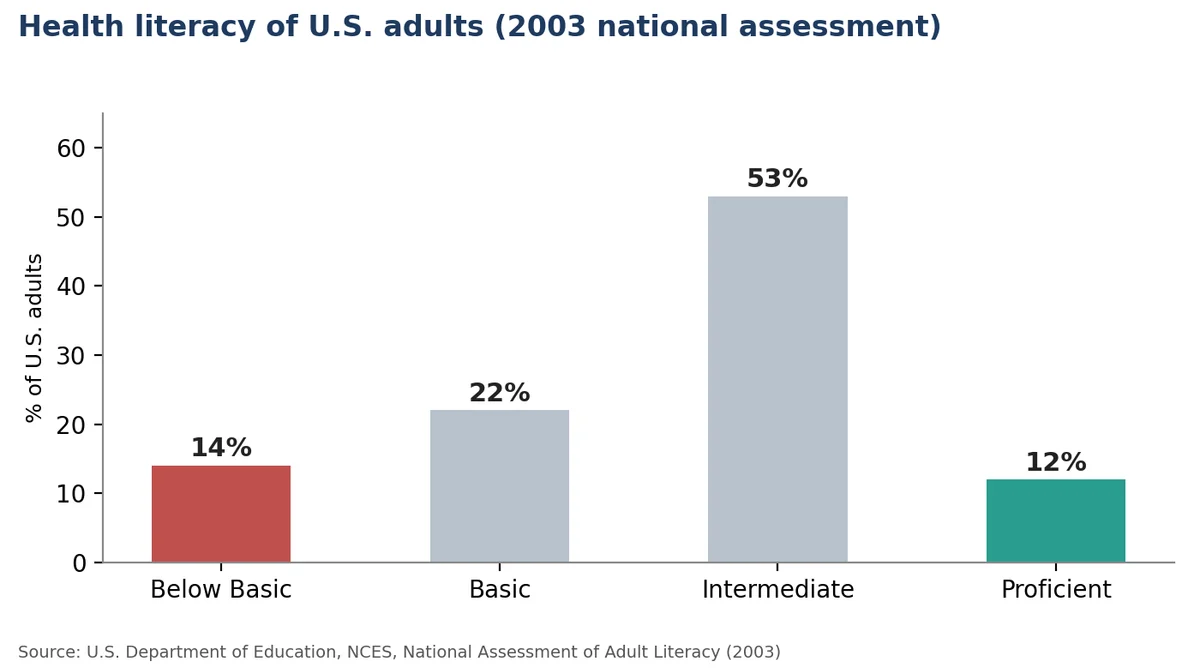
The U.S. Department of Education's National Assessment of Adult Literacy measured health literacy among American adults. Only 12 percent were proficient. About 53 percent were intermediate, 22 percent basic and 14 percent below basic. In total, 36 percent had trouble with moderately difficult tasks like reading a chart to find when a child should get a vaccine, or reading a prescription label to spot substances that might interact.
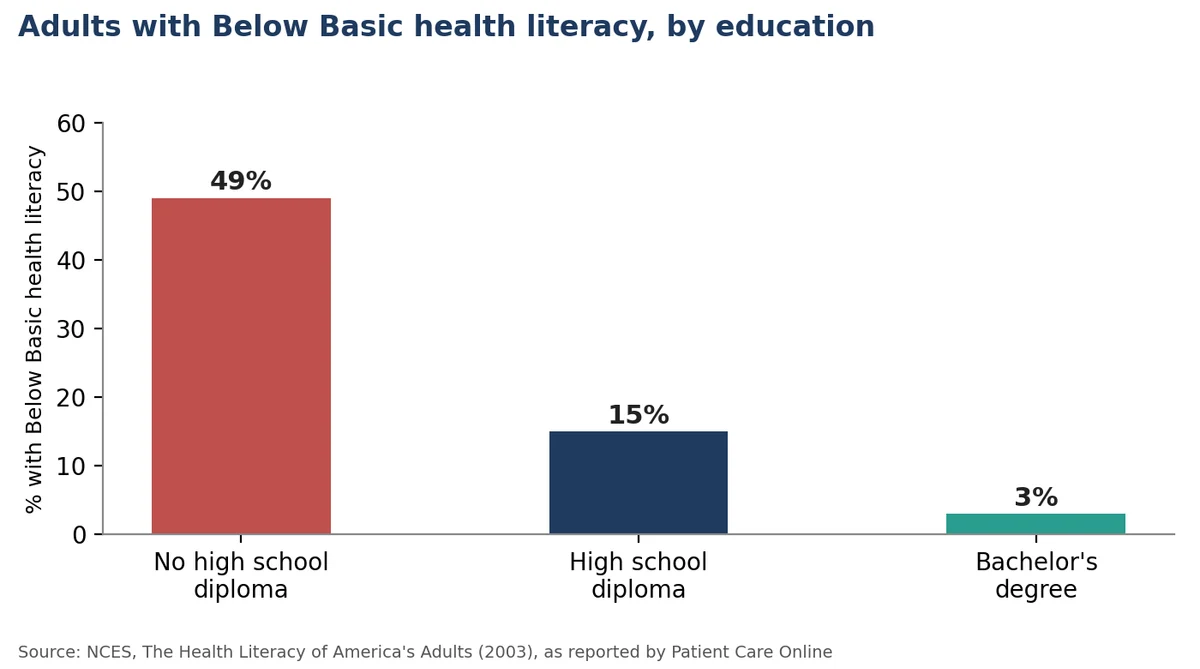
The gaps aren't evenly spread. Among adults who never finished high school, 49 percent had below basic health literacy, compared with 15 percent of high school graduates and 3 percent of college graduates. The same assessment found 27 percent of Medicare recipients and 30 percent of Medicaid recipients in the below basic group.
These figures come from a 2003 federal assessment, so treat them as a benchmark rather than today's exact numbers. The clinical point still holds. Patients without strong health literacy can struggle with self-care, managing chronic disease, filling out forms and sharing their history. A plan the patient can't follow isn't much of a plan.
Unhurried visits and plain-language explanations
Follow-up matters as much as the first conversation. KEL reviews progress at later visits and adjusts the plan as needs change, which gives patients a second chance to ask what they didn't catch the first time.
Results
They aren't alone. Adam Cunningham wrote that KEL's staff "listen and are very willing to help you." Across more than 486 verified reviews, KEL holds a 4.9 out of 5 Google rating.
A clinician's take on explaining well
Listening and explaining are two halves of the same skill. A clinician who listens first learns what the patient is worried about, and that shapes how the plan gets explained. Then the explanation has to land in everyday words.
For patients with limited health literacy, this is often what separates a plan they follow from one they quietly abandon. Clear language, one step at a time, and an invitation to ask questions all help. So does a team that welcomes questions at every point in the visit, from the front desk to the exam room.
What patients can take from this
Before you leave any appointment, make sure you can say what the plan is, what to do next and who to call with questions. A good practice will be glad to repeat it. KEL welcomes walk-ins and accepts most major plans, including Medicare, Medicaid, Fidelis Care, Healthfirst, MetroPlus, EmblemHealth, UnitedHealthcare and BlueCross BlueShield.