Women HealthBy KEL Healthcare Medical
How Lifestyle Counseling Transforms Lives
Women who kept five healthy habits lived 14 years longer, and men 12, in a Harvard study of more than 120,000 adults. Adherence is very low, which is where lifestyle counseling comes in.

Introduction
Women who kept five healthy habits lived 14 years longer, and men 12, in a Harvard study of more than 120,000 adults. Adherence is very low, which is where lifestyle counseling comes in.
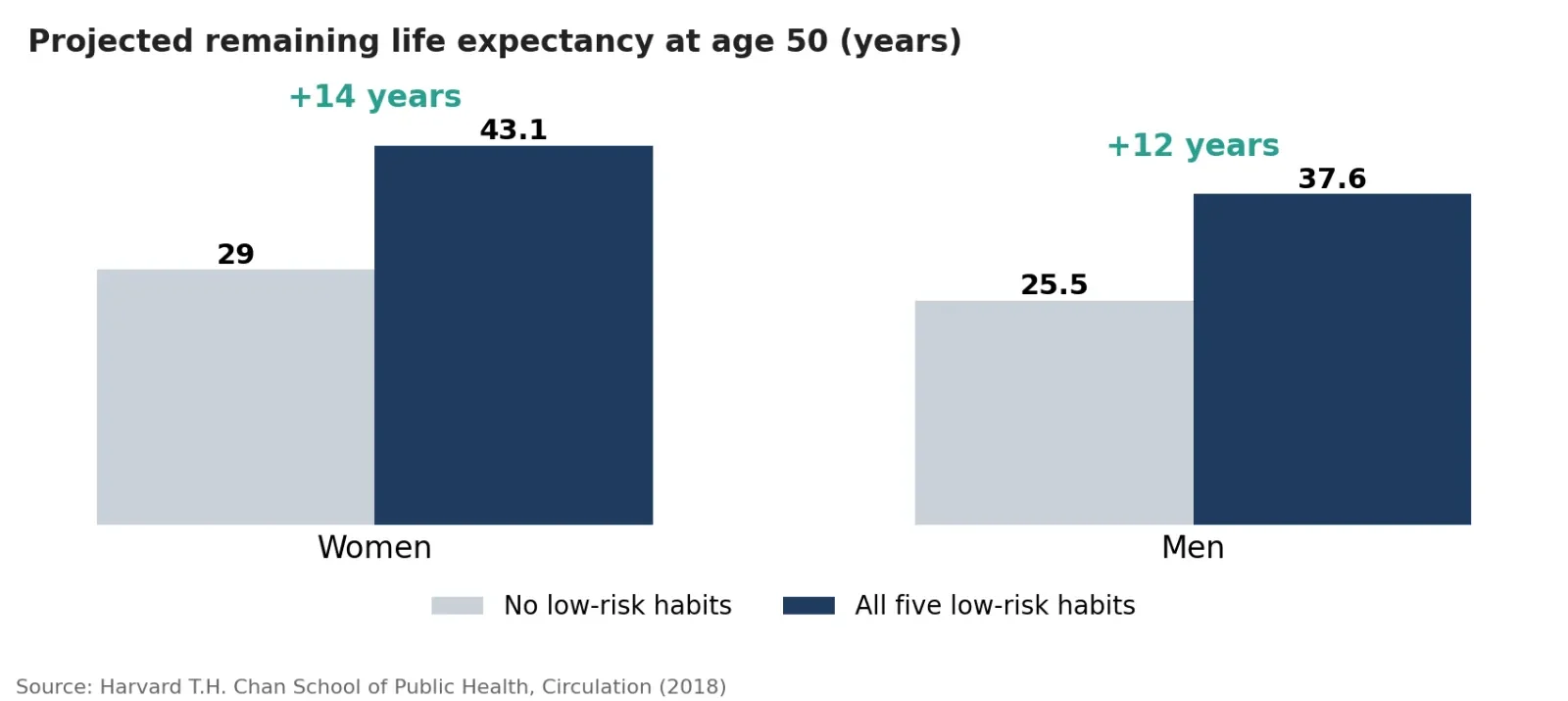
The numbers are striking. A Harvard T.H. Chan School of Public Health study followed 78,865 women for 34 years and 44,354 men for 27 years. Women who kept five low-risk habits had a projected life expectancy at age 50 of 43.1 more years, versus 29 for women with none. For men it was 37.6 years versus 25.5. That's 14 extra years for women and 12 for men. But the researchers also noted that adherence to healthy lifestyle habits is very low. Knowing what to do isn't the problem. Doing it, week after week, is. That's the gap lifestyle counseling is designed to close.
Key Findings
- 14 years of added life expectancy at age 50 for women, and 12 years for men, who kept all five low-risk habits (Harvard Chan, Circulation, 2018).
- 5 habits were studied: never smoking, a healthy weight, 30+ minutes of daily activity, moderate alcohol and a healthy diet.
- Dose-response: each individual healthy habit was linked with lower risk of early death, and the combination with the most added years (Harvard Chan).
- 93.1 and 87.6 were the average ages reached by 50-year-old women and men who kept all five habits (American Heart Association summary).
What did the Harvard study actually find?
That habits stack, and that every one counts. The researchers used data from the Nurses' Health Study and the . They compared people who adopted none of the five low-risk factors with those who adopted all five, and found the largest gains in the group with all five. Because it was an observational study, it shows a strong association rather than proof of cause, and the participants were health professionals, so results may differ in other populations. Still, the pattern of each extra habit lowering risk is hard to ignore.
What are the five habits, exactly?
They're simpler than they sound, and the definitions are modest. Here's how the study defined "low risk," and a realistic first step for each.
| Habit | How the study defined it | A starting point |
|---|---|---|
| Not smoking | Never smoking | If you smoke, ask about quit programs |
| Healthy weight | BMI 18.5 to 24.9 | Focus on habits first, then the scale |
| Physical activity | 30+ minutes a day, moderate to vigorous | A brisk 10-minute walk, three times |
| Moderate alcohol | Up to one drink a day (women), two (men) | Add alcohol-free days |
| Healthy diet | More vegetables, fruit, nuts, whole grains; less red and processed meat, sugary drinks and sodium | Add one vegetable to one meal |
Why don't more people do it?
Because change is hard, and information alone rarely changes behavior. Most people already know they should walk more and eat better. What gets in the way is time, stress, habit, cost and motivation, and stress and sleep often drive weight and eating habits more than people expect. A single list of "do's" from a doctor rarely survives a busy week. This is why researchers keep pointing out that adherence is low even among people who understand the benefits.
How does lifestyle counseling help habits stick?
It turns a big goal into small, trackable steps, with someone to check in. A good counselor, whether a doctor, nurse, dietitian or health coach, usually does a few things. A dedicated lifestyle counseling service builds all of these into regular visits:
- Starts with your priorities. The first habit is the one you're ready to change, not the one that sounds most impressive.
- Sets a specific goal. Effective goal setting is concrete: "walk 15 minutes after lunch, five days a week" beats "exercise more."
- Plans for obstacles. What will you do on a rainy day, or when your schedule collapses?
- Builds in accountability. A follow-up call, a weekly check-in or a group makes it harder to quietly drop the habit.
- Celebrates progress. Motivation grows when you notice what's working.
Which habit should you start with?
The one you'll actually keep. The dose-response finding is encouraging: you don't need to perfect all five at once. Each habit moved in the right direction is linked with lower risk. If you smoke, quitting is usually the biggest single step. If not, many people find a daily walk the easiest entry point, because it needs no equipment and can be built up gradually. These small habit changes with the biggest health impact are a good place to begin.
Conclusion
The Harvard data suggests that ordinary habits, practiced together, are linked with more than a decade of added life. The challenge is consistency, and that is exactly what lifestyle counseling targets: clear goal setting, honest barriers and steady accountability. Start with one habit, add support, and build from there.
More from our blog
 Lifestyle Therapy
What Is Lifestyle Therapy. and Why Is It the New Blockbuster Medicine?
A lifestyle program beat metformin for preventing type 2 diabetes in a landmark trial, but the results depend on intensive coaching and long-term effort.
Medically reviewed by Dr. Karl E. Latortue, MD
Read Article Lifestyle Counseling
How Lifestyle Counseling Can Help You Live Your Healthiest Life
Lifestyle counseling helps you improve your health through six key pillars: healthy nutrition, physical activity, restorative sleep, stress management, social connections, and avoiding risky substances. Start with small, realistic changes and seek professional guidance to build sustainable habits, prevent health problems, and manage chronic conditions with support from KEL Healthcare.
Medically reviewed by Dr. Karl E. Latortue, MD
Read Article Osteoarthritis and Chronic Joint Pain
Osteoarthritis and Chronic Joint Pain: Staying Active With a Long-Term Plan
Osteoarthritis is a leading cause of chronic joint pain, but a long-term plan built around movement, weight management, and safe pain relief can help you stay active and independent.
Medically reviewed by Dr. Karl E. Latortue, MD
Read Article