Lifestyle Counseling in Primary CareBy Kel Healthcare Medical Services PC.
Lifestyle Counseling in Primary Care: Effectiveness Strategies and Clinical Implications
Primary care is where most people would hear about food, movement and smoking, and it's where that conversation is shortest. An observational study of 116 older patients' visits found that the.

Introduction
In one study of 18-minute primary care visits, physical activity got 58 seconds of conversation. Here's what makes lifestyle counseling work despite the clock.
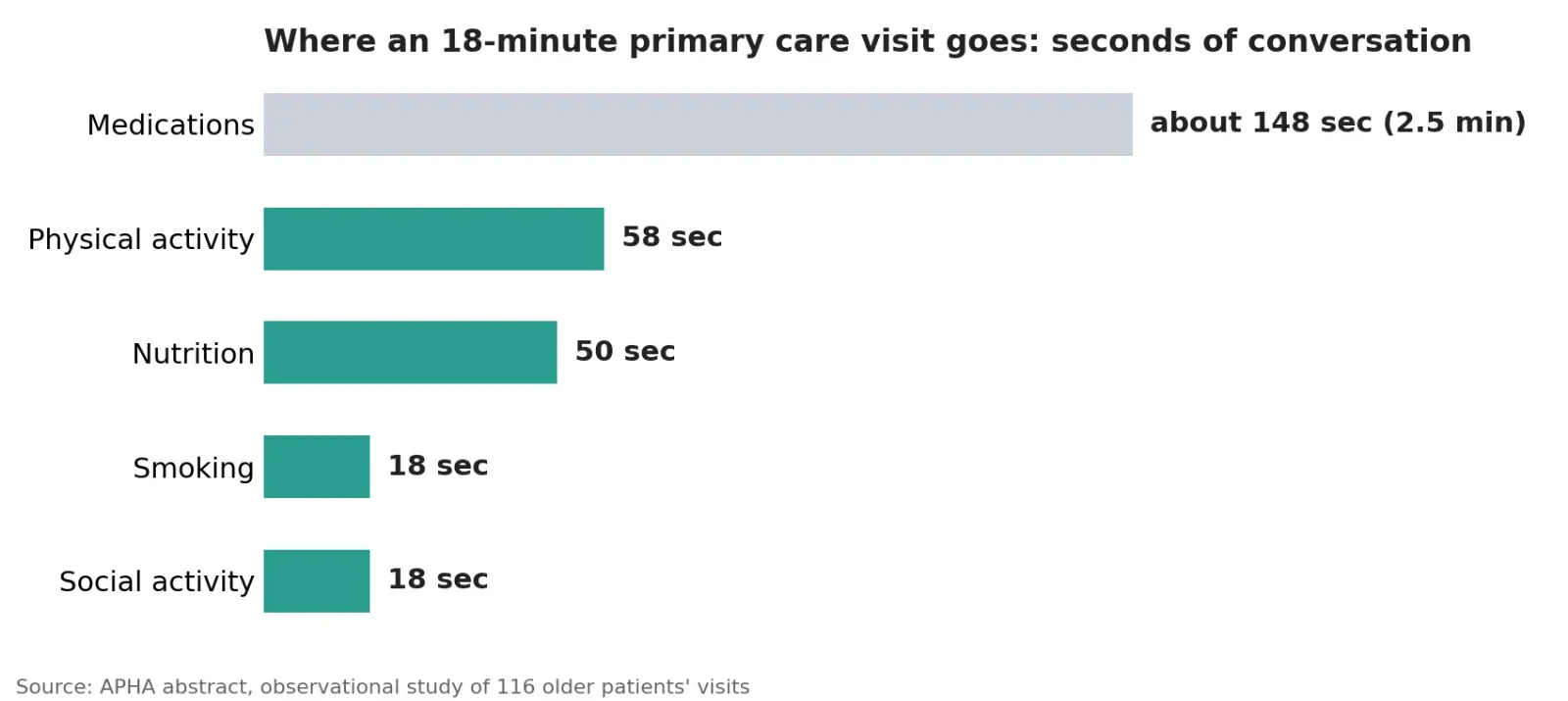
Primary care is where most people would hear about food, movement and smoking, and it's where that conversation is shortest. An observational study of 116 older patients' visits found that the average visit lasted 18 minutes, yet physical activity got 58 seconds of talk, nutrition 50 seconds and smoking 18, while medications took about 2.5 minutes (APHA abstract). In a survey of 161 general practitioners in Lodz, Poland, only 3.7% always advised patients on diet and exercise, and 73.3% named lack of time as the main barrier. So does lifestyle counseling actually work in primary care? The evidence says yes, when it's structured, and the gaps are fixable.
Key Findings
- 58 seconds of an average 18-minute visit went to physical activity in an observational study of older patients (APHA abstract).
- 73.3% of surveyed GPs cited lack of time as the main barrier to counseling, and over 40% doubted they were effective (Frontiers in Public Health, 2023).
- About one-third of primary care visits include nutrition counseling, even though poor diet contributes to almost half of U.S. cardiometabolic deaths (Journal of Primary Care & Community Health, 2025).
- 83% of physicians used at least one of the Five A's in weight-loss encounters, but they rarely assessed, assisted or arranged follow-up (Duke University, Family Medicine).
Why does lifestyle counseling get so little time?
Because visits are short, and counseling isn't built into the workflow. financial disincentives and doubt about effectiveness as the main obstacles. Depending on the study, as few as 25% of U.S. primary care physicians feel adequately trained to counsel on diet and lifestyle, according to a Clinical Correlations review. The result is advice that's brief and general. Doctors gave general advice more often to patients who already had a chronic disease than to people who were still healthy, the Polish survey found, which means prevention is where the conversation is thinnest.
What are the Five A's, and do they work?
They're a simple counseling framework, and they work best when all five steps happen. The Duke study recorded 461 overweight patients and 40 physicians. Doctors routinely asked and advised patients to lose weight, but rarely assessed, assisted or arranged follow-up. Since each step supports the next, skipping the last three is where counseling tends to fall apart.
| Step | What it looks like in a short visit | Why it matters |
|---|---|---|
| Ask | "Can we talk about your eating and activity?" | Builds permission and trust |
| Advise | One clear, personal recommendation | Keeps the message simple |
| Assess | A quick check of readiness and confidence | Matches advice to where the patient is |
| Assist | One specific goal and a plan | Turns advice into action |
| Arrange | A follow-up visit, call or referral | Makes it stick over time |
What does effective counseling look like in a short visit?
Small, specific and followed up. You can't drive behavior change in two minutes, but you can start. A few approaches make the minutes count:
- Use a pre-visit questionnaire. A 2025 paper describes a short tool patients complete before the appointment, so the "assess" step doesn't eat visit time.
- Pick one goal. The American College of Lifestyle Medicine describes co-creating SMART goals with patients (specific, measurable, achievable, relevant, time-bound). Starting with small habit changes that make the biggest health impact keeps that goal realistic.
- Hand off. Nurses, dietitians and health coaches can carry the follow-up, and group programs can reinforce it.
- Book the next touchpoint. "Arrange" is the step most often skipped, and it's the one that turns a comment into a habit.
How can patients get more from the visit?
Come with one question and one honest barrier. You don't need a long list. Try opening with something like "I want to walk more, but my evenings are packed. What would you suggest?" That gives your doctor a concrete problem to solve in the time available. Stress and poor sleep are common hidden barriers, and this guide on how lifestyle counseling connects stress, sleep and weight shows why they are worth mentioning. Naming what drives you, such as keeping up with your grandchildren, gives your doctor a way to build on your own patient motivation. Also ask about referrals to a dietitian, a physical therapist or a group lifestyle program, because those can give you the hours your visit can't.
When should counseling go beyond the doctor's office?
When the goal is bigger than one conversation can carry. Chronic disease management, including prediabetes, high blood pressure, obesity or a heart condition, usually takes weeks of structured support. Patients are often at different stages of readiness for different habits, as an American Journal of Lifestyle Medicine paper notes. A structured program, such as dedicated lifestyle counseling with regular check-ins, meets people where they are, one pillar at a time.
Conclusion
Lifestyle counseling in primary care is hampered less by lack of evidence than by lack of minutes. The fix is practical: use all five A's, set one clear goal, hand off follow-up to a team, and arrange the next contact before the patient leaves. Those steps turn a 58-second chat into the start of lasting behavior change, and they work best when they build on patient motivation.
Frequently Asked Questions
More from our blog
 Women Health
How Lifestyle Counseling Transforms Lives
Women who kept five healthy habits lived 14 years longer, and men 12, in a Harvard study of more than 120,000 adults. Adherence is very low, which is where lifestyle counseling comes in.
Medically reviewed by Dr. Karl E. Latortue, MD
Read Article Lifestyle Therapy
What Is Lifestyle Therapy. and Why Is It the New Blockbuster Medicine?
A lifestyle program beat metformin for preventing type 2 diabetes in a landmark trial, but the results depend on intensive coaching and long-term effort.
Medically reviewed by Dr. Karl E. Latortue, MD
Read Article Lifestyle Counseling
How Lifestyle Counseling Can Help You Live Your Healthiest Life
Lifestyle counseling helps you improve your health through six key pillars: healthy nutrition, physical activity, restorative sleep, stress management, social connections, and avoiding risky substances. Start with small, realistic changes and seek professional guidance to build sustainable habits, prevent health problems, and manage chronic conditions with support from KEL Healthcare.
Medically reviewed by Dr. Karl E. Latortue, MD
Read Article